A Multiple Exposure Exploration of Stockholm
Introduction
Sweden is often thought of as a country of lakes, forests and Scandinavian efficiency, along with that much-admired work-life balance. But there is much more to Sweden than forests and countryside, and its capital, Stockholm, is a fascinating city built around water. If you fancy joining me for a Swedish Multiple Exposure adventure then CLICK HERE
Stockholm is spread across 14 islands, connected by more than 50 bridges, while the wider Stockholm archipelago contains more than 30,000 islands. The city sits where Lake Mälaren meets the Baltic Sea, and its location has played an important role in its history and development. Stockholm was founded in the 13th century, with the oldest part of the city, Gamla Stan, developing on the island of Stadsholmen.
Today, Stockholm is a wonderfully varied city, with historic buildings, colourful architecture, waterways, green spaces and a modern underground system that has become famous for its art. From a photography point of view, there was plenty to explore, but rather than simply photographing the sights in the conventional way, I wanted to think about how I could interpret different parts of the city through multiple exposure.
So how would I go about photographing Stockholm? It went a little bit like this...
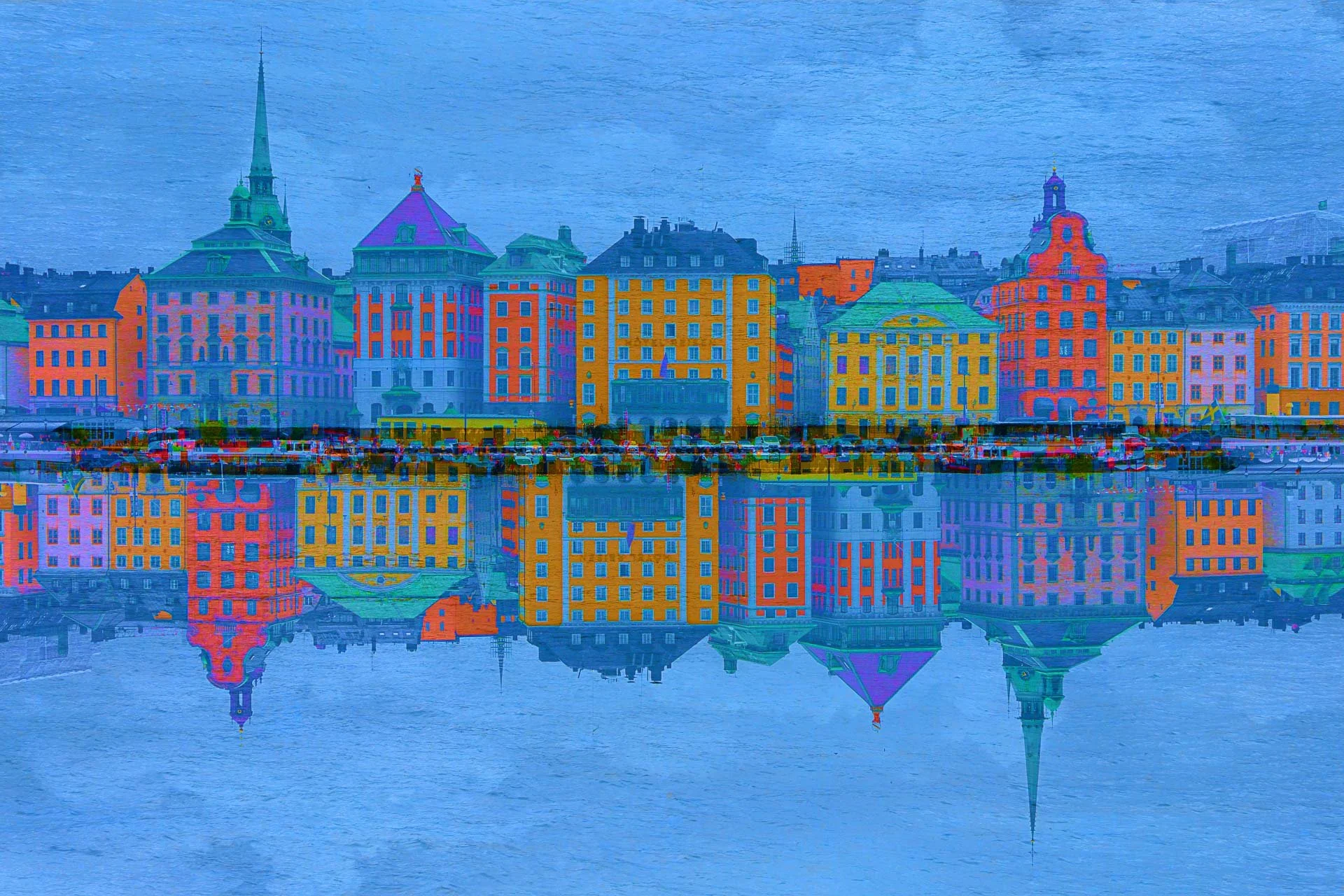
A multiple exposure 180 flip of the harbour buildings in Stockholm
The Harbour – Flip, Colour and Experimentation
With so much water running through Stockholm, it was inevitable that I would spend quite a lot of time around the harbour. One of the first techniques I chose was my 180-degree flip, because the colourful houses on the other side of the water created such a lovely line and I could immediately see how they might work when flipped and combined.
I love the way a 180-degree flip can take something very recognisable and turn it into something much more abstract. The buildings are still there, but the relationship between them changes, and suddenly you're looking at shapes, lines and colours rather than simply a row of houses.
I also decided to play with colour in this creation, using the Saturation blend mode. I use this blend mode so rarely that I was particularly intrigued by the effect it produced with this combination of layers. Sometimes the blend modes we don't regularly reach for can give us the biggest surprises, and I really liked the way the colours interacted here. I added a final texture layer too, which helped to pull the whole creation together.
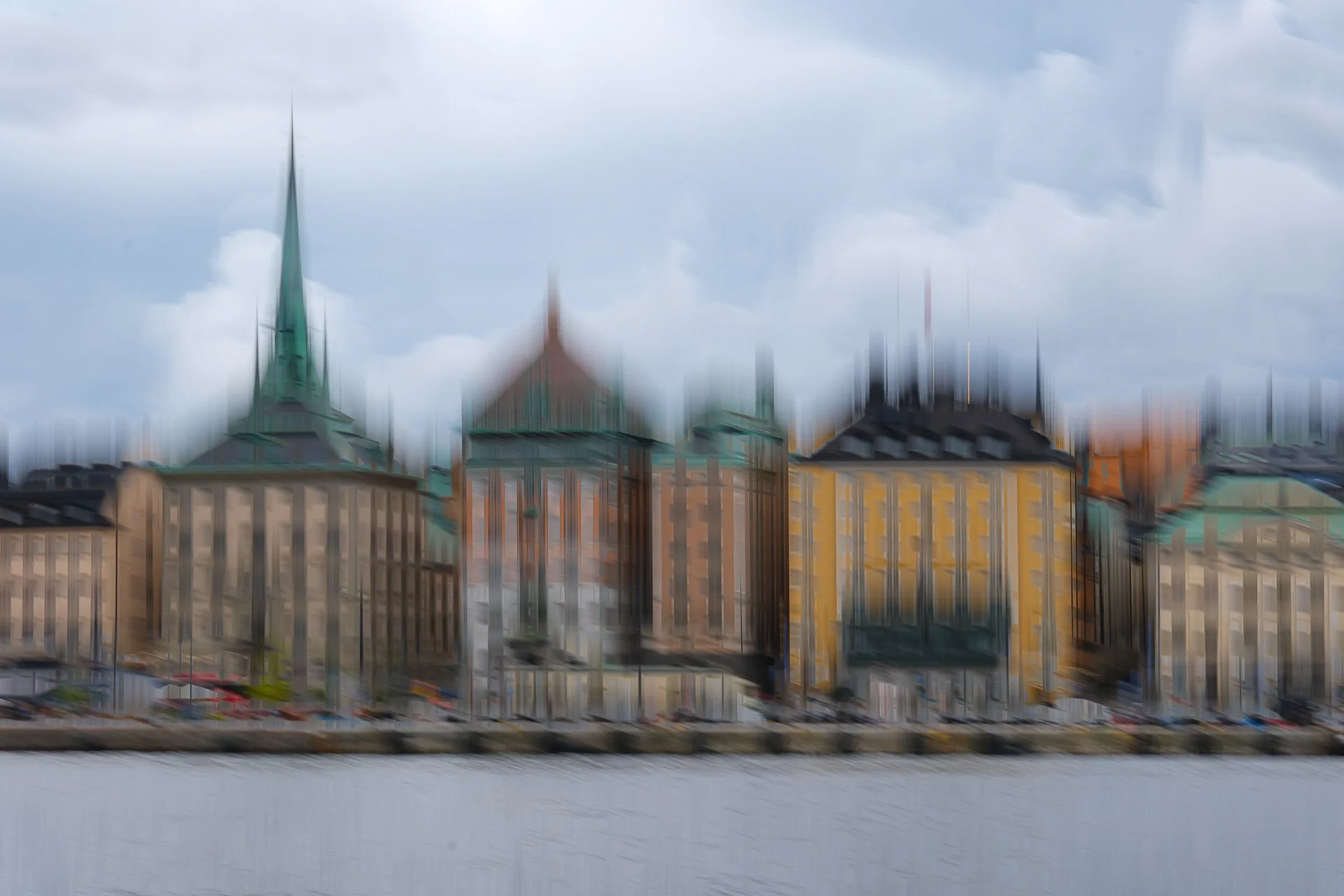
A cross hatched multiple exposure of the houses on Stockholm’s harbour
The Harbour Again – A Little Crosshatching
Apparently, one visit to the harbour wasn't enough!
I found that view also suggested crosshatching, with the angles of the buildings and the strong colours giving me plenty to work with. I used the technique by combining a vertical camera movement with a horizontal one, creating layers that moved across each other and transformed the architecture into something much more abstract.
I particularly like using crosshatching with buildings because the strong architectural lines work so well with the movement. Rather than trying to keep everything straight and perfectly recognisable, the technique allows those lines to stretch, overlap and become part of the overall design.
I really like the finished image, but now I'm going to make you choose: which one do you prefer, the 180-degree flip or the crosshatched version? I think they both work, but they have a very different feel despite using the same buildings.
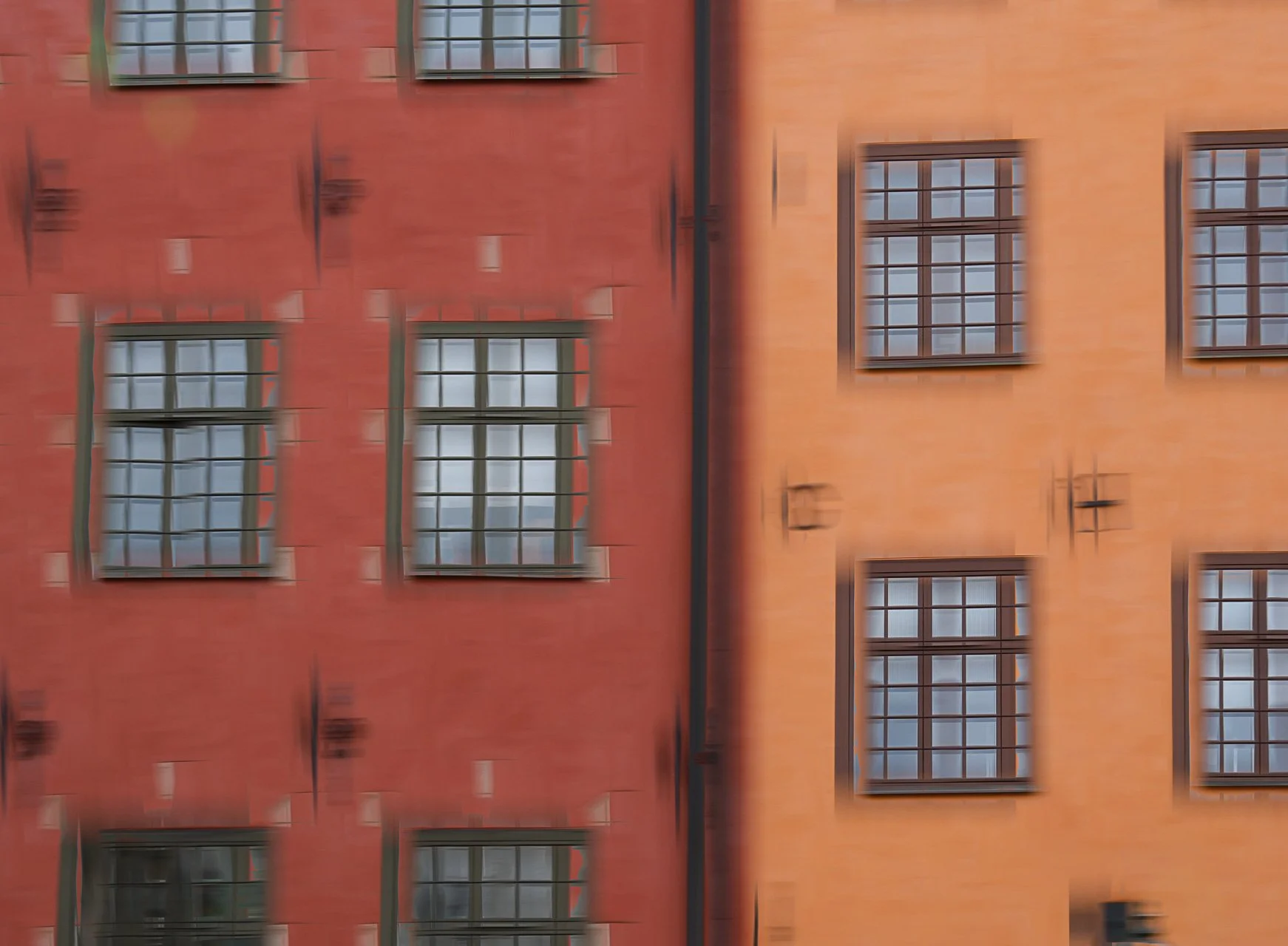
A multiple exposure of the colours of the centre of Gamla Stan
Gamla Stan – Colour, History and a Nodding Squirrel!
Next stop was Gamla Stan, Stockholm's Old Town and one of the city's most atmospheric areas. Dating back to the 13th century, it is centred around the island of Stadsholmen and is one of the largest and best-preserved medieval city centres in Europe. Its narrow, winding streets, cobbled lanes and colourful historic buildings make it a wonderful place to explore, and for a photographer there seems to be something interesting around almost every corner.
The colours were fabulous and I particularly loved the fact that so much of the area was car-free, which made wandering around with a camera much more enjoyable. I also discovered that Gamla Stan is a rather good place to simply sit and watch the world go by. I really enjoyed stopping for lunch and a drink in the main square, Stortorget, and spending some time people-watching as well as eating.
You could easily while away a lot of time here, browsing the many little shops and cafés. You could pick up a moose-covered tea towel, find yourself a pair of cosy warm socks or simply stand outside one of the shops watching the nodding squirrel in the window.
I kid you not!
From a multiple exposure point of view, however, Gamla Stan was a little more challenging. The narrow streets and number of people meant that I didn't always have the space I wanted to make my camera movements, but I decided to work with what I had rather than fight against it. I used crosshatching with Dark blend mode, and I really like the way it captures those bright colours of the oldest buildings while still retaining the feeling of movement.

A multiple exposure image turning the camera by 90 degrees each time.
Church Towers – Going Round in Circles
The church towers in Gamla Stan were particularly good subjects for another technique I love using with architecture: rotating the camera four times by 90 degrees. This creates four layers of the same subject, each at a different orientation, and when the images are combined the result can be surprisingly geometric.
The towers provided plenty of strong shapes and colours to work with, and I really enjoyed seeing how the architecture changed as the camera moved around it. It's one of those techniques where you have an idea of what might happen, but the finished result can still be a bit of a surprise.
The clock faces can get a little deformed when you use this technique, particularly when you're pointing the camera upwards, because the perspective changes as you rotate. But sometimes I think this actually adds to the design. After all, I'm not trying to create a perfectly accurate record of the building; I'm trying to create something that feels different.
And sometimes a slightly wonky clock face is exactly what the image needs!
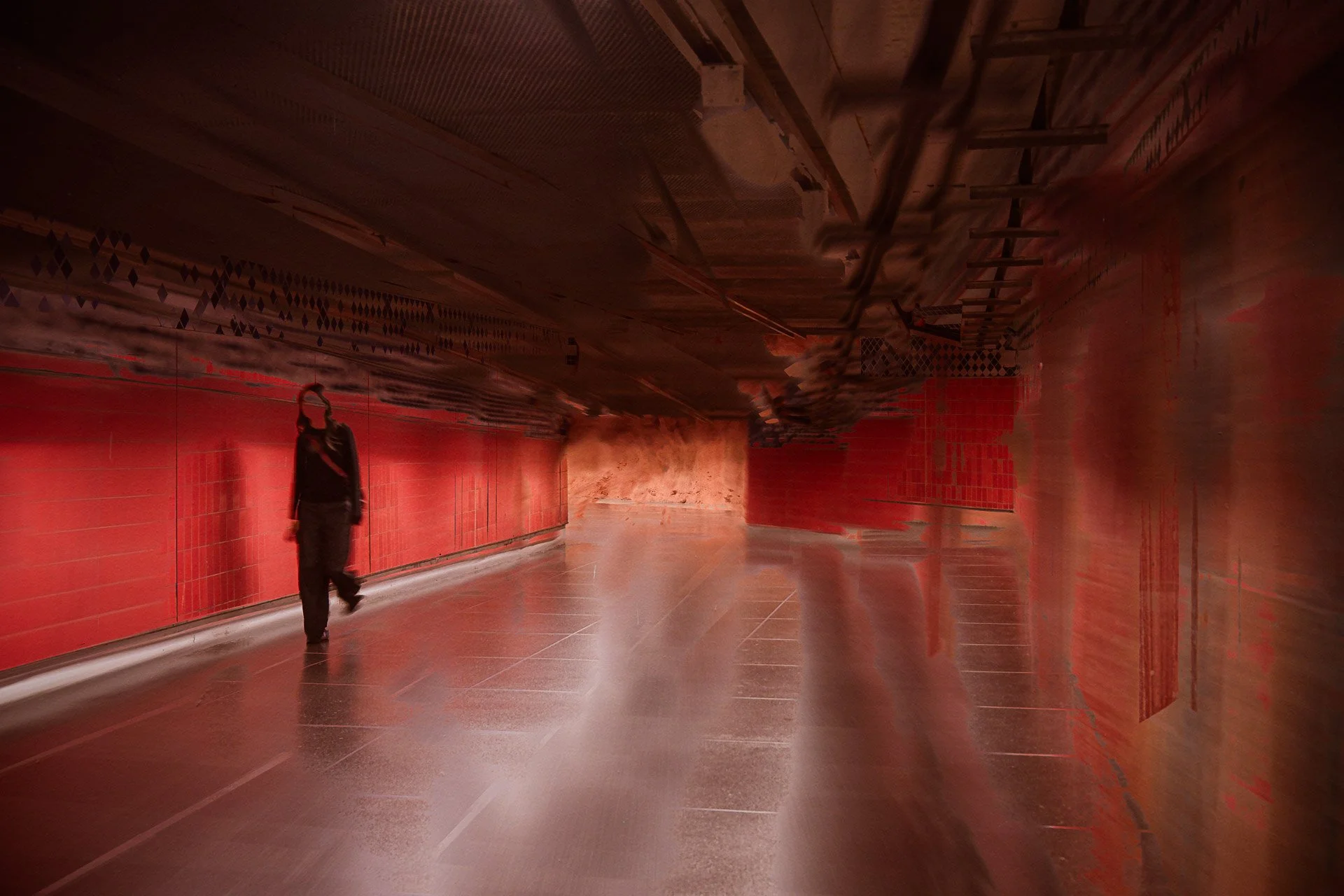
A multiple exposure image of Stockholm’s underground.
The Underground – Art Beneath the City
I couldn't visit Stockholm without exploring its famous underground system, which is often described as the world's longest art exhibition. The Stockholm Metro stretches for around 110 kilometres and has 100 stations, with more than 90 featuring artwork created by hundreds of artists, designers and architects.
Artwork has been incorporated into the system since the 1950s, and the stations vary enormously. Some feature huge painted cave-like spaces, while others contain mosaics, sculptures, installations and bold graphic designs. T-Centralen, for example, was the first station to feature artwork when it opened in 1957, and its famous blue-line platform has a dramatic blue and white design.
From a multiple exposure point of view, there was almost too much to choose from. The colours, textures, patterns and shapes were fantastic, and I quickly realised that I hadn't left myself nearly enough time to explore the underground in the way I really wanted to.
I guess that means I'll have to return.
Oh well!
For this image I used Dark blend mode and added an extra layer of the red wall, which helped to bring that strong colour into the final creation. I also have many other photographs that I took specifically with the intention of using them to create images in post-processing, so watch this space because I suspect there may be more Stockholm underground images appearing in the future.
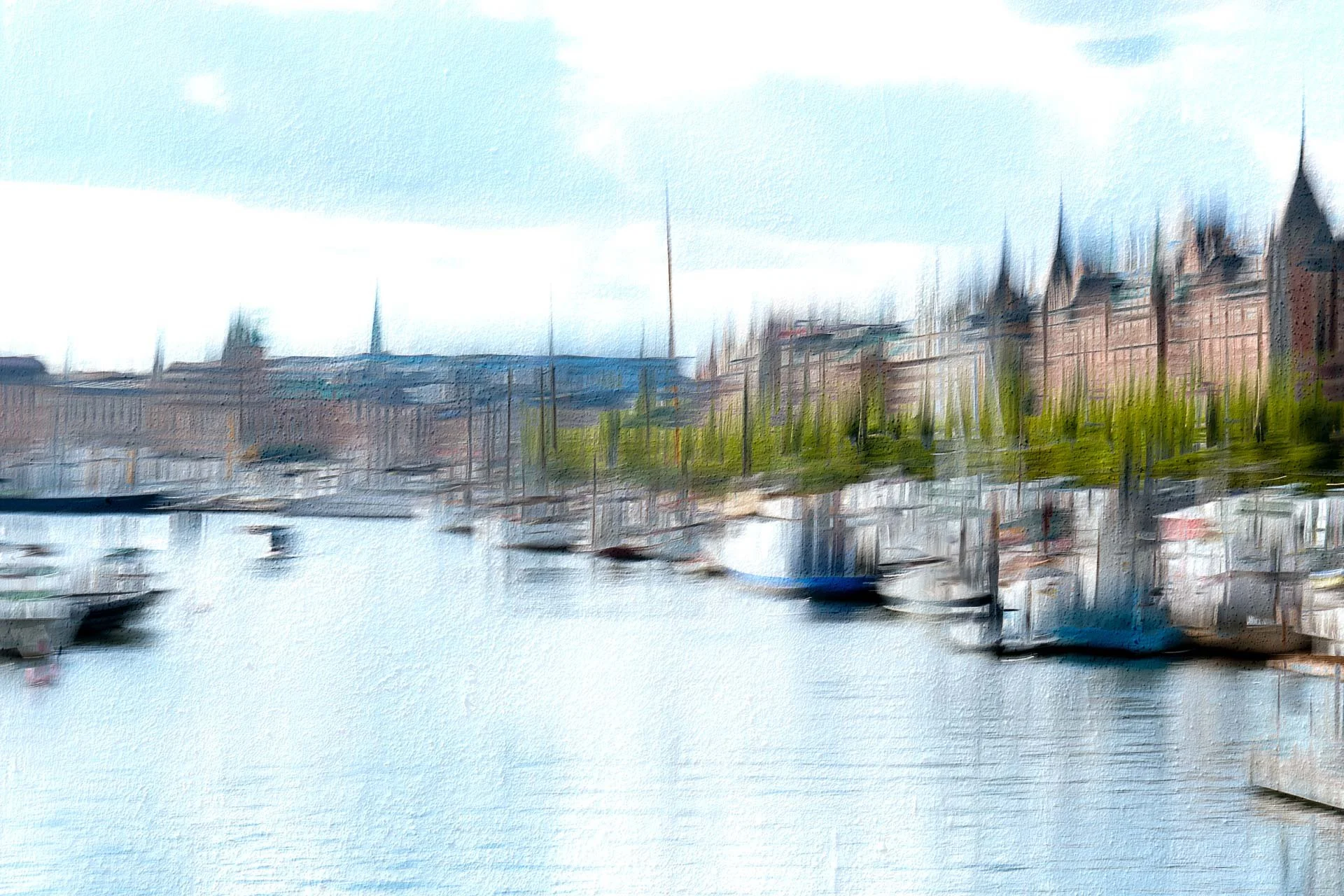
Another cross hatched multiple exposure but of a different part of the waterfront in Stockholm
Conclusion – Seeing Stockholm Differently
One of the things I love most about multiple exposure photography is that it encourages me to slow down and really look at a place rather than simply recording what is in front of me. When visiting a new city, it's very easy to move from one famous landmark to another, taking the expected photograph along the way, but multiple exposure makes me stop and consider the shapes, colours, movement, direction and light before deciding how I want to interpret what I'm seeing.
Stockholm turned out to be a wonderful playground for this. The harbour offered colourful buildings and reflections, Gamla Stan gave me bright historic architecture and fascinating details, the church towers provided strong shapes for rotation and the underground presented a completely different world of colour and pattern.
What I particularly enjoyed was that I wasn't trying to create a definitive photographic record of Stockholm. Instead, I was trying to create my own interpretation of the places I visited, and that's one of the great freedoms of multiple exposure photography. You don't necessarily need to find a different subject – sometimes you just need to find a different way of seeing it.
So now it's over to you: which of these images is your favourite, and which technique would you have tried if you had been exploring Stockholm with your camera? I'd love to know whether you prefer the 180-degree flip, the crosshatched harbour image, the colourful buildings of Gamla Stan, the rotated church tower or the underground creation, and perhaps your choices will give me some inspiration for what to explore when I inevitably return to Stockholm!
If you want to visit Sweden with the Wilde Academy then do CLICK HERE for more info!