There are some places that you visit as a photographer where you immediately start seeing possibilities everywhere you look. Crosby Beach in Merseyside is one of those places for me.
Situated just north of Liverpool, Crosby is a huge expanse of beach looking out across the Irish Sea. At first glance, it is a beautiful but fairly typical stretch of coastline, with wide skies, shifting sands and the ever-changing sea. But then you notice them. A figure standing in the distance. Then another. And another. These are Antony Gormley's Another Place sculptures: 100 life-sized cast-iron figures standing along the shoreline and stretching for around two miles. They look out towards the sea, each one standing in a slightly different relationship to the water and the landscape.
I am not usually someone who would describe a place as spiritual, but there is something about Another Place that I find incredibly moving. There is a stillness here that is difficult to explain. The figures are silent and solitary, standing in the landscape as the sea constantly changes around them. They are slowly covered and uncovered by the tides, weathered by the elements and gradually becoming part of the environment they inhabit.
For me, watching the tide go out is particularly magical. As the water retreats, the sculptures begin to appear, one by one. At first, you might spot the head and shoulders of one figure emerging from the water. Then, slowly, more of the body is revealed. Some are covered in barnacles and seaweed, while others stand on the wet sand, surrounded by reflections. Eventually, they are all standing on solid ground, but the landscape they occupy has changed completely.

A five Layer Multiple Exposure at Crosby Beach four in camera images with a texture layer from post processing.
And, of course, as a photographer, I absolutely love it.
Every time I visit, I find something different to photograph. The light changes. The weather changes. The tide changes. The sculptures themselves seem to change depending on where you stand and how you photograph them. It is somewhere I can spend hours experimenting with multiple exposure, looking for new ways to interpret these familiar figures.
I am so looking forward to next week when I will be returning to Crosby with five lovely workshop participants. I have just added a new Crosby workshop date in October too, so if you fancy exploring this extraordinary place with me, there is now another opportunity to join me. CLICK HERE
And if you are a woman and can't wait until October, there are also places available on the Crosby and Liverpool Docks weekend workshop, which I am running in collaboration with SheClicks and co-leading with the wonderful Angela Nicholson. This is a brilliant opportunity to explore both the atmospheric sculptures of Crosby and the architectural and industrial possibilities of Liverpool's historic docklands. CLICK HERE.
There are so many different techniques I use when I visit Crosby, so I thought I would share five of my favourite ways to approach photographing Another Place.
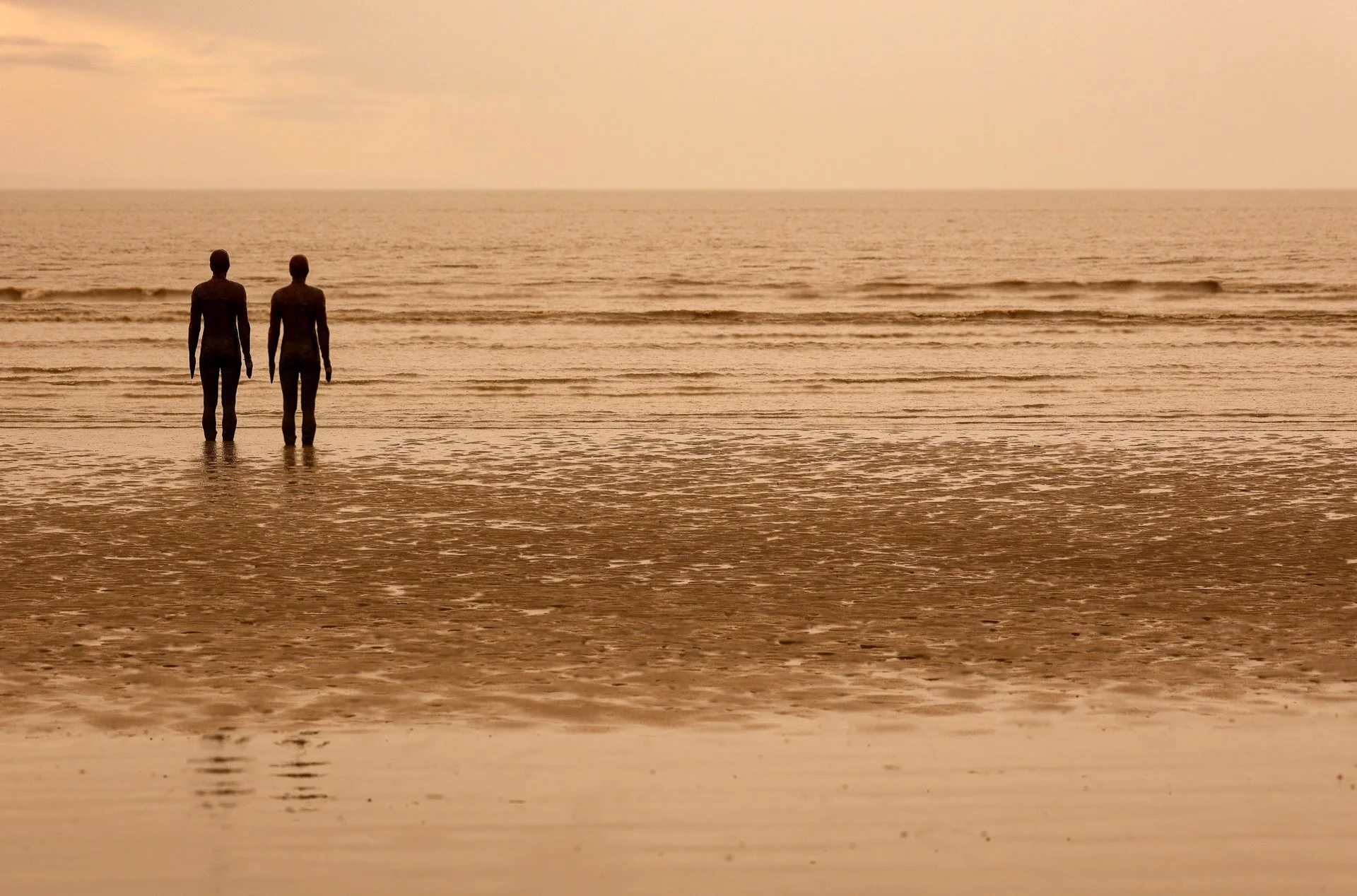
An in camera double exposure of the Antony Gormley Figures - Side by Side
1. Keeping It Simple – Moving the Statues Closer Together
One of the challenges of photographing Another Place is that the sculptures are spread across such a huge distance. Although there are 100 figures along the beach, you rarely find more than one or two within your frame at any one time. This is where multiple exposure can be so much fun.
By recomposing your image between each exposure, you can bring the sculptures closer together than they actually are. Suddenly, instead of having one solitary figure standing in the landscape, you can create a group of figures that appear to be standing together. If there are no people wandering around the beach, this can create a beautifully minimalistic image, with just the sculptures and the landscape. Or you can combine more figures, as I have in the top image, simply by changing your composition slightly for each exposure.
This is something that can be done very easily in camera, but if your camera doesn't quite give you the composition you had in mind, you can always make small adjustments in post-processing. You could even add another layer or two afterwards to take the creative possibilities even further.
I think this is one of the joys of photographing Another Place. You can take what is actually there and subtly rearrange it into something that feels completely different.

An in camera double exposure of Crosby Beach
2. 180-Degree Flips – Who Said They Were Just for Buildings?
You thought 180-degree flips were reserved for buildings, didn't you? Well, apparently not!
After the success I've had using this technique with skylines and buildings, I should probably have realised that it would work beautifully with the horizon and seascape too. I've also had some great results using 180-degree flips with hedgelines, so perhaps this shouldn't have come as such a surprise!
For this image, I've incorporated the wonderful wind farm into the composition, which adds another layer of interest and detail. The repeated forms of the wind turbines work particularly well with the 180-degree flip, creating a slightly surreal landscape that makes you stop and look twice.
I have to admit, though, that I've just noticed there are people in this image rather than sculptures! I clearly wasn't paying enough attention when I created it. I am now looking forward to trying this again next week, this time with the Gormley figures, and seeing what happens when I recompose the image around them. And that is one of the things I love about multiple exposure photography. You can have an idea about how you think a technique will work, but sometimes the happy accidents and unexpected results are even more interesting.
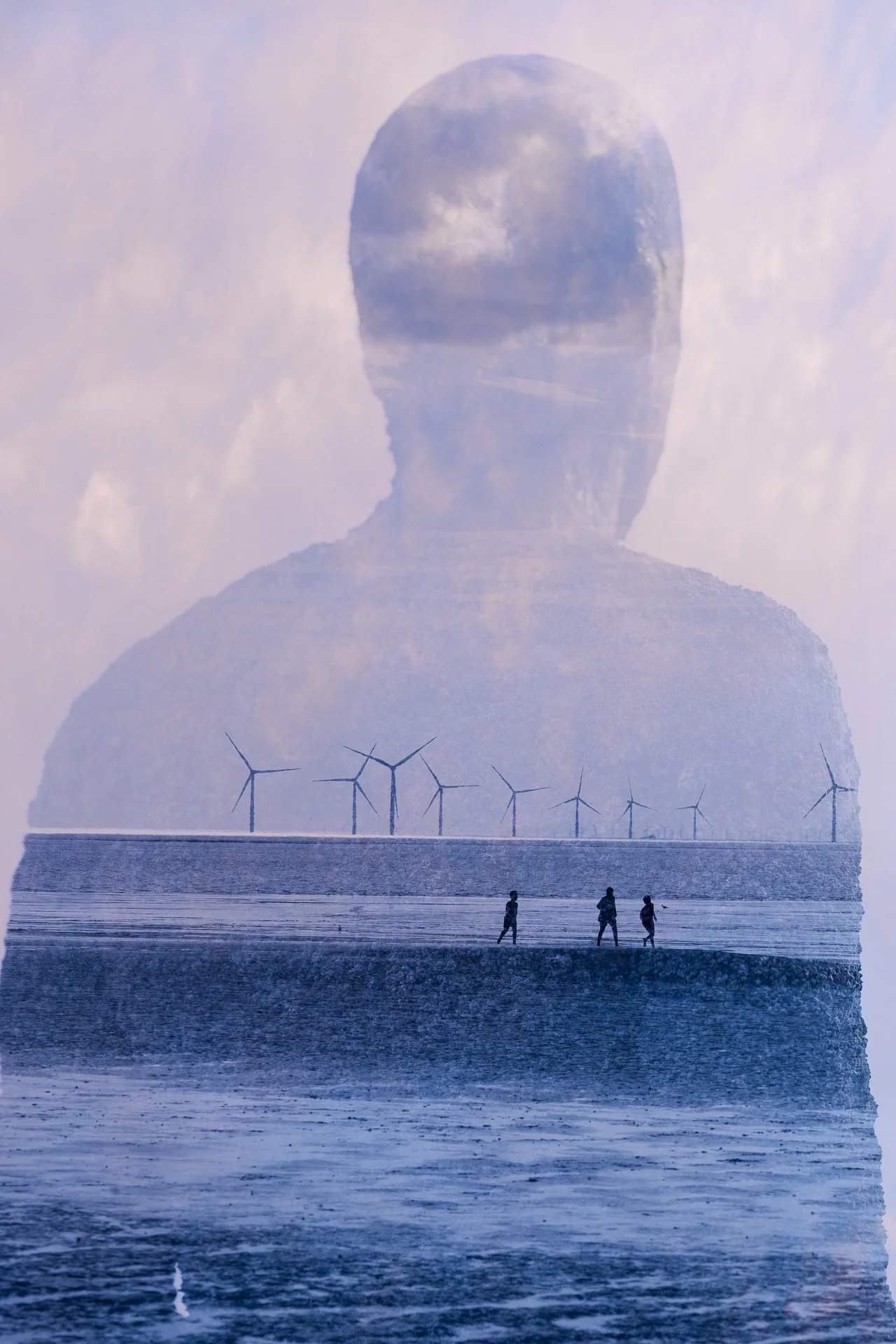
An in camera double exposure on Crosby beach
3. Using the Statues as a Silhouette
This is another really simple technique that can produce a wonderfully creative result. For this image, I photographed one of the Gormley figures directly into the sun, creating a strong, dark silhouette.
I then used Lighten blend mode for my second frame and photographed the beach scene. The reason this works is because the Lighten blend mode looks at the pixels in each layer and chooses the lightest ones. Because the statue is dark against the bright sky, the lighter beach scene effectively replaces the darker areas of the figure. The result is a really interesting composition where the beach and landscape appear within the shape of the statue, almost as though the figure has become a window onto the scene behind it. I love the way this technique allows you to combine the physical presence of the sculpture with the environment around it. The statue is still recognisable, but it has become part of the beach rather than simply standing on it.
If you would like to learn more about blend modes and how you can use them creatively in your multiple exposure photography, do have a look at the blend modes PDF I've put together. Understanding how the different blend modes work can really open up a whole new world of possibilities when you're creating multiple exposures.

An in camera double exposure of Crosby beach
4. You Can't Beat a Bit of Bokeh!
You can't beat a bit of bokeh – and there is plenty of it to be found on a beach in the afternoon sunshine!
When the sun is bouncing off the shallow water and wet sand, you can create some beautiful, shimmering highlights. By deliberately defocusing your lens, those tiny points of reflected light become soft, dreamy circles of bokeh. I love using this as a second layer in a multiple exposure because it can be combined with so many different compositions from the beach. You can photograph a sculpture, a person, the horizon or even a very simple section of sand and sea, and then layer the bokeh over the top to add an extra sense of atmosphere. The beauty of this technique is that you don't really need to know exactly what you're going to create before you start. Find some beautiful light, deliberately take your camera out of focus and see what happens when you combine it with your other images.
Sometimes the best thing you can do is simply take your camera, head to the beach and give yourself permission to play. Don't worry too much about whether every frame is going to work. Experiment, try something unexpected and see where it takes you. You might just create something completely different from anything you had imagined.

An in camera double exposure with a change of white balance between frames
5. Playing with White Balance
Finally, let's talk about one of my favourite ways to introduce colour into a multiple exposure: white balance.
This works particularly well on a beach because you have such a wonderful combination of blues, yellows and warm sunlight to play with. By combining one exposure taken with a very blue (low) Kelvin number and another taken with a very yellow (high) Kelvin number, you can create some beautiful colour combinations within a single image.The two different white balance settings can interact in really interesting ways, allowing you to introduce contrasting shades of blue and yellow into different parts of your photograph. The result can be subtle and atmospheric or much more vibrant and surreal, depending on the images you choose to combine.
I particularly love experimenting with this at Crosby because the beach already gives you such a beautiful, pared-back palette. You don't need lots of complicated subject matter. The sea, sky, sand and sculptures provide everything you need, and the white balance becomes another creative tool that you can use to transform the scene.
If you would like to explore this technique further, do have a look at my white balance PDF, where I go into more detail about how you can use different Kelvin settings creatively in your multiple exposure photography.

A double exposure in camera image of Crosby beach
A Place I Keep Coming Back To
I think that is what makes Crosby such a special place for me as a photographer. It offers endless creative possibilities, but it never feels as though you have to force them. The beach, the sea, the changing light and the sculptures are constantly creating new opportunities for you. You can arrive with a plan and leave having photographed something completely different. You might spend an hour experimenting with multiple exposure and then suddenly find yourself captivated by a single sculpture standing alone in the mist. You might photograph reflections, silhouettes or textures, or simply watch as the tide slowly reveals the figures one at a time.And perhaps that is why I find Another Place such a magical and, for me, unexpectedly spiritual location. The sculptures encourage you to slow down and be present. They stand there, day after day, whatever the weather, while the landscape around them constantly changes. There is something incredibly grounding about that.
I can't wait to return next week and share this experience with five lovely workshop participants. I am already wondering what the weather and tide will bring us and what new images we will create together.
If you'd like to join me at Crosby, I've just added a new workshop date in October. And if you're a woman, and don't want to wait that long, there are also places available on the Crosby and Liverpool Docks weekend workshop, in collaboration with SheClicks and co-led with the wonderful Angela Nicholson. CLICK HERE.
Whether you are completely new to multiple exposure or already love experimenting with creative techniques, Crosby is a location that gives you the freedom to play, explore and see things differently.
And who knows? Perhaps, like me, you'll find that once you've visited Another Place, you will always want to return.
As always, if you have enjoyed this blog please do leave a comment and if you haven’t already join the Creative Circle by signing up HERE and The Multiple Exposure Hub HERE or check out the workshops and courses HERE.