Multiple Exposure Architecture Photography in London: Creative Techniques for Striking Images
Introduction
When you first begin exploring multiple exposure photography, it can feel as though there are endless techniques to choose from. With so many possibilities available, it’s easy to experience a moment of creative paralysis when you’re standing in front of an interesting subject and wondering which approach will work best. Over time, however, you begin to realise that certain subjects lend themselves particularly well to certain styles of multiple exposure.
One of my absolute favourite subjects to work with is architecture in London. The city offers an extraordinary variety of buildings, from historic landmarks to modern glass structures, all packed into a relatively compact area. Nowhere demonstrates this quite like the South Bank, where iconic landmarks sit alongside bold contemporary architecture. As you walk along the river, you encounter an inspiring mix of textures, lines, reflections and shapes that are perfect for experimenting with multiple exposure techniques.
The South Bank area is home to some of London’s most recognisable sights, including the nearby Elizabeth Tower, the cultural complex of the Southbank Centre, and the pedestrian walkway that leads to the striking Millennium Bridge. With views stretching across the Thames to historic buildings such as St Paul's Cathedral, it’s an endlessly inspiring place for photographers.
It’s also where I frequently run photography workshops. I lead multiple exposure workshops in London, Brighton and Birmingham, as well as women-only photography weekends in Brighton and Birmingham, where we spend time exploring creative techniques together in a relaxed and supportive environment. If you enjoy experimenting and learning alongside other photographers, do come and join the fun.
Let’s look at a few of my favourite techniques for photographing London architecture using multiple exposure.

A multiple Exposure Photography Image of the Elizabeth Tower (Big Ben)
Creating an Impressionistic Feel
One technique I love for architectural subjects is creating an impressionistic multiple exposure. This approach involves taking photographs of the same building from many different angles and combining them either in camera or later in Photoshop.
The key to making this work is to maintain a consistent focal point as you move around the structure. While the rest of the image shifts and overlaps, the repeated focus point helps anchor the viewer’s eye.
For example, when photographing Elizabeth Tower (often referred to as Big Ben, although technically Big Ben is the bell inside the tower), I concentrated specifically on the clock face. As I walked around the building capturing images from slightly different angles, the clock remained the visual anchor throughout the exposures.
A little history adds context to this iconic subject. Elizabeth Tower was completed in 1859 as part of the rebuilding of the Palace of Westminster after a devastating fire in 1834. The clock mechanism was designed by Edmund Beckett Denison, while the bell itself—known as Big Ben—quickly became one of London’s most recognisable sounds. The tower was officially renamed Elizabeth Tower in 2012 to commemorate Queen Elizabeth II’s Diamond Jubilee.
By focusing on the clock face while moving around the building, the final multiple exposure maintains a clear point of interest while the surrounding architecture blends into a beautifully layered, impressionistic interpretation of the tower.
You can apply this idea to many other buildings. The focal point might be a roof detail, a distinctive window, or a decorative element. Experiment and see what works best for your subject.
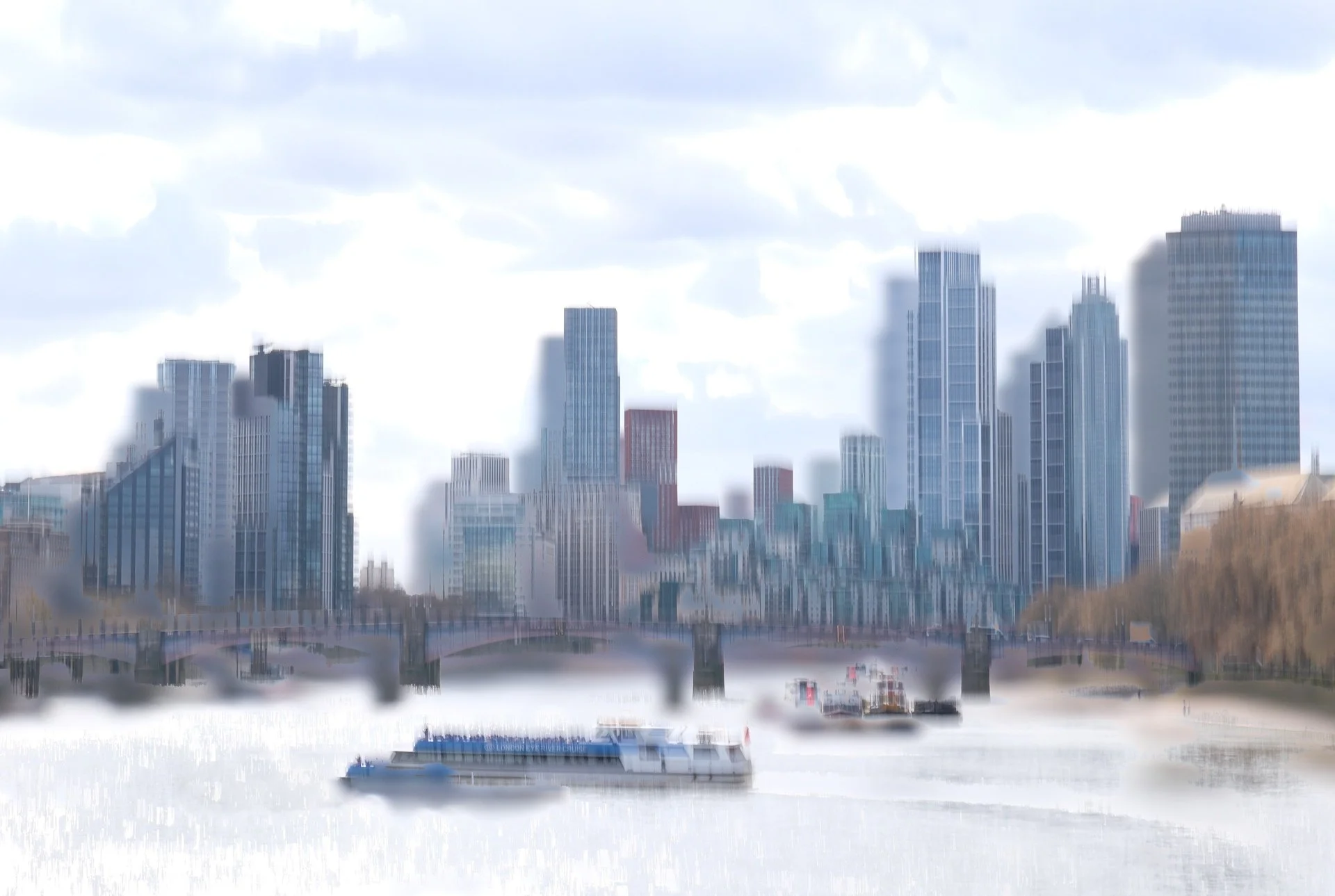
A Multiple Exposure Photography image of skyscrapers in London
In and Out of Focus with Dark Blend Mode
Another technique that works beautifully with London architecture is combining a sharp image with an out-of-focus exposure using dark blend mode.
I’ve recently started returning to this approach when photographing buildings, and the results have been very interesting. Dark blend mode tends to deepen tones and alter colours in subtle ways, which works particularly well with the textures and materials commonly found in London architecture.
For this technique, I always find it easiest to compose the sharp image first. Once that frame is captured, I create the second exposure by:
Opening the aperture to achieve a very low f-stop
Switching to manual focus
Slightly zooming in
The second image becomes soft and blurred, creating a shadow-like layer over the original structure. When the two exposures combine in camera, the effect is a subtle yet atmospheric interpretation of the building.
Although the order technically makes no difference to the final result, starting with the sharp image simply makes the composition easier to visualise for me.

A Multiple Exposure Photography Image of the view from the Millenium Bridge
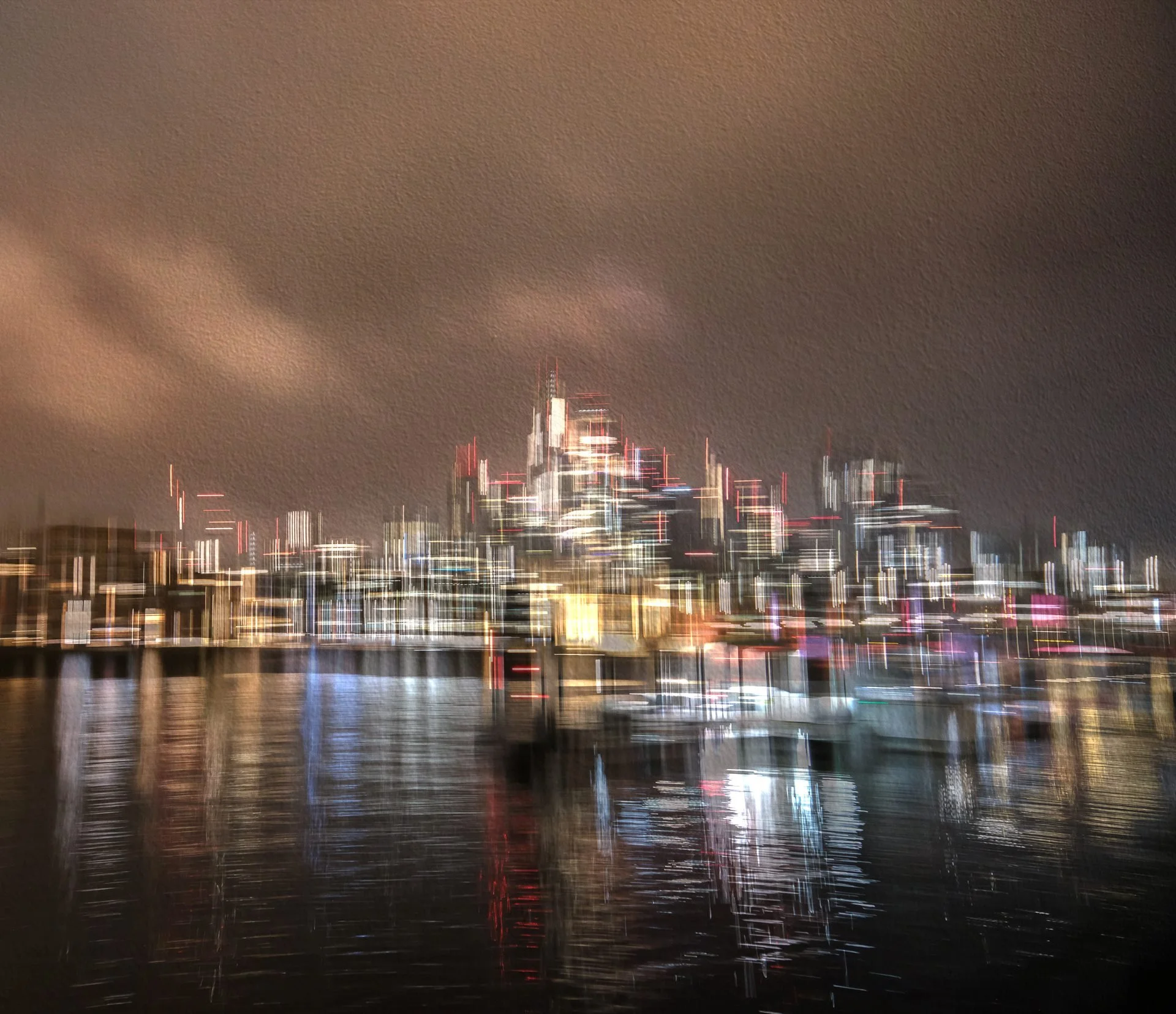
Cross-Hatching with Camera Movement
Of course, I couldn’t talk about multiple exposure techniques without mentioning cross-hatching.
This technique uses deliberate camera movement combined with slower shutter speeds. With an aperture of around 1/15 or 1/8 of a second, you create the effect by:
Moving the camera vertically during the first exposure
Moving the camera horizontally during the second exposure
When the two images combine, the overlapping movements create a pattern of small crosses—hence the name cross-hatching.
One of my favourite locations for this technique is the Millennium Bridge. Opened in 2000, the bridge connects the South Bank with the area around St Paul's Cathedral. Interestingly, shortly after opening it gained the nickname “The Wobbly Bridge” because of an unexpected swaying motion caused by pedestrian footsteps. Engineers later fixed the issue with dampers, and today it’s one of the most popular pedestrian crossings in London. There is still a bit of movement so it’s a good job this technique involves movement.
Photographically, it’s a wonderful view. The distinctive shape of The Shard, combined with the constantly changing sky above the Thames, create endless opportunities for expressive cross-hatching images. I especially love how the technique interacts with cloud movement and changing light.
Again, dark blend mode can be particularly effective here. If your camera doesn’t offer this option, simply capture the exposures using average blend mode and then combine them later in Adobe Photoshop using dark blend mode.

A Multiple Exposure Photography Image of the Elizabeth Tower (Big Ben) in London
Four Different Angles
This next technique is one that had been dormant in my photography for a while but has recently made a comeback.
Rather than flipping the camera 180 degrees between exposures, this method involves rotating the camera by 90 degrees for each exposure, producing four images that combine into a single symmetrical composition.
One example comes from photographing Elizabeth Tower from the opposite side of the Thames. Because of the angle I wanted I was standing close to the railings that run along the pavement right beside the building.
At first I thought the railings might spoil the composition, but they actually ended up framing the tower beautifully in the final multiple exposure. It was a lovely reminder that sometimes the things we initially think will get in the way can actually enhance the image.
This technique works particularly well when you have a strong central element to focus on.
A great example is the nearby OXO Tower. By centring the camera on the large “X” in the tower’s distinctive signage and rotating the camera between exposures, you can create striking symmetrical patterns.
It’s also a good reminder that in a genre as unpredictable as multiple exposure photography, the best approach is often simply to try it and see what happens.

A Multiple exposure photography image of the Saints statues on St Paul’s Cathedral, London
Adding Impact with Post-Processing
While I love creating images in camera, post-processing can sometimes take an image to another level.
In one example, I captured a single photograph of the statues on top of St Paul's Cathedral, photographed from a rather unusual viewpoint high above the ground. (If you’re curious about exactly where, you may have to join one of my workshops to find out!)
Back at the computer, I decided to experiment in Adobe Photoshop. I added:
A layer of sunset tones
A layer of white paint texture
The combination transformed the image into a striking minimalist composition, where the architectural details stand boldly against a simplified background.
It’s a great reminder that while multiple exposure often happens in camera, post-processing is another creative tool that can dramatically enhance the final image.

A Multiple Exposure Photography image of London Bridge Station
Conclusion
Multiple exposure photography offers a wonderful way to explore architecture in a more creative and expressive way. From impressionistic layering around iconic landmarks like Elizabeth Tower, to in-camera focus techniques, cross-hatching movement, and rotational compositions, there are many approaches you can experiment with when photographing the extraordinary architecture of London.
The key is simply to try different techniques and see what resonates with you. Some ideas will work brilliantly, others may surprise you, and occasionally something unexpected will become a new favourite method.
If you’d like to explore these techniques further, you’re very welcome to join me on one of my multiple exposure workshops in London, Brighton or Birmingham, or on one of my women-only photography weekends. It’s a fantastic way to learn new techniques, experiment creatively, and spend time with other photographers who enjoy pushing the boundaries of what the camera can do.
You can also explore more tutorials and inspiration by joining the Multiple Exposure Hub on Facebook, subscribing to the newsletter, or browsing the range of courses and workshops available.
The world of multiple exposure is wonderfully creative—and London’s architecture provides the perfect playground to explore it.